All articles
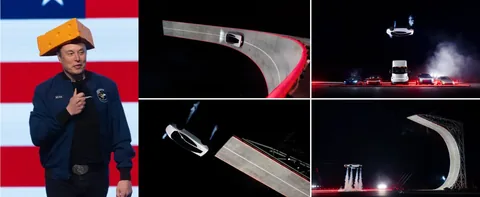
Sensing Beyond AI and Spatial Intelligence: The Extreme Physics Behind Tesla's 'Flying' Roadster
Elon Musk promised a flying car; the McGregor demo delivered mid-air kickflips. Here is the sub-millisecond sensor telemetry, reaction control physics, and underbody suction that made it possible.
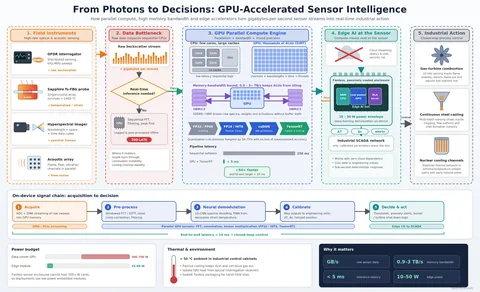
Accelerating Sensor Intelligence: The Role of GPUs, Edge AI, and Parallel Computing
How parallel GPU architectures, high memory bandwidth, and edge accelerators bridge the gap between high-speed sensor acquisition and real-time industrial inference.
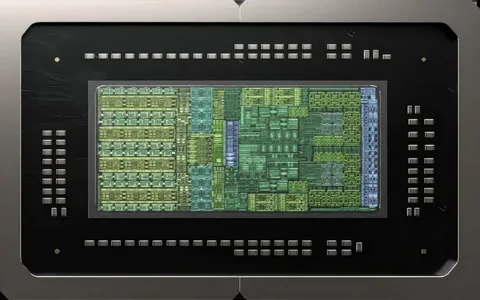
From G80 to Vera Rubin: Two Decades of Architectural Disruption in GPU Computing
Tracing the evolution of GPU architectures from the monolithic G80 unified shader revolution in 2006 to the multi-die Vera Rubin AI supercomputing platforms of 2026.
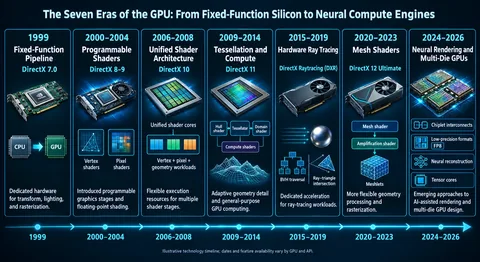
The Seven Eras of the GPU: From Fixed-Function Silicon to Neural Compute Engines
A comprehensive analysis of GPU evolution through 2026: tracing the seven distinct eras from hardware T&L and programmable shaders to neural rendering and multi-die architectures.
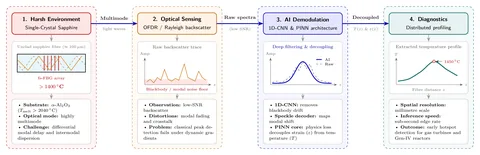
AI-Driven Sapphire Optical Fiber Sensors: Decoding Harsh Environment Distributed Sensing
How machine learning and physics-informed models overcome multimode modal dispersion and noise to unlock distributed sapphire fiber sensing above 1300°C.
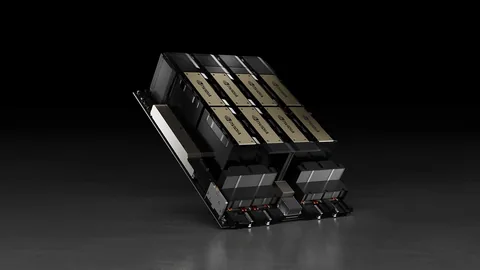
The Multi-Gigawatt AI Bottleneck: What 600k GPUs Mean for Thermal Sensing and Liquid Cooling
Meta's multi-GW clusters and 600,000+ GPUs reveal the next physical frontier: why massive power density requires fiber-optic thermal monitoring and extreme-temperature power generation.
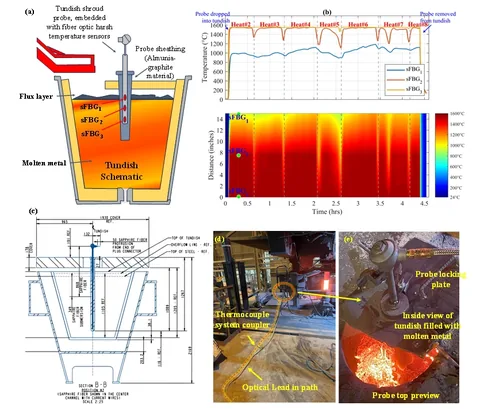
Solving the Steel Industry's Blind Spot: Real-Time, Multi-Depth Tundish Temperature Monitoring
A multiplexed sapphire FBG sensor array delivered continuous, multi-depth temperature and slag-line data inside a live steel tundish at SSAB Iowa.
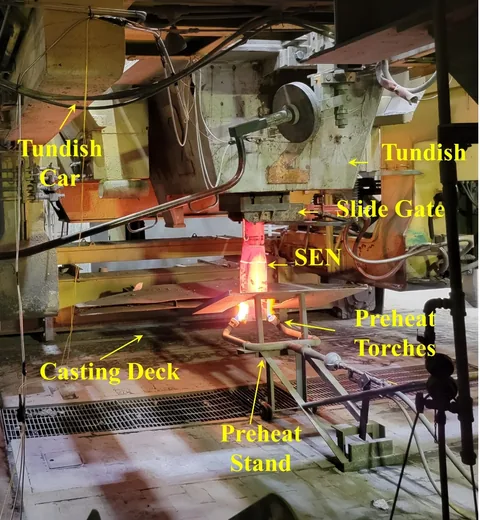
Revolutionizing Steelmaking Process Control: Real-Time Distributed Thermal Profiling in Submerged Entry Nozzles (SENs)
How a flexible single-crystal sapphire tube sheath lets cascaded sapphire FBGs deliver real-time distributed thermal mapping inside Submerged Entry Nozzles at 1600°C.
Solving the Multimode Noise Barrier: How Rapid Heat Treatment Boosts Signal-to-Noise Ratio by 10 dB
Rapid heat treatment at 100°C/min solves signal-to-noise degradation in multimode sapphire FBGs, yielding a ~10 dB fringe visibility gain and stability at 1600°C.
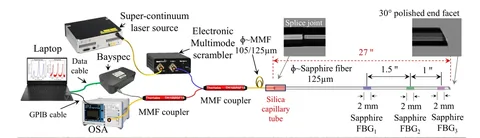
Engineering Fiber Optic Sensors for Harsh Environments: Packaging, Interrogation, and Signal Processing
How splicing, mode scrambling, linear AWG interrogation, and FFT noise analysis isolate clean 1600°C sapphire FBG signals from blackbody radiation and vibration.
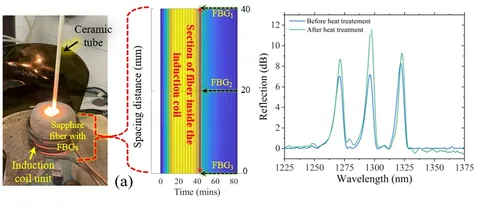
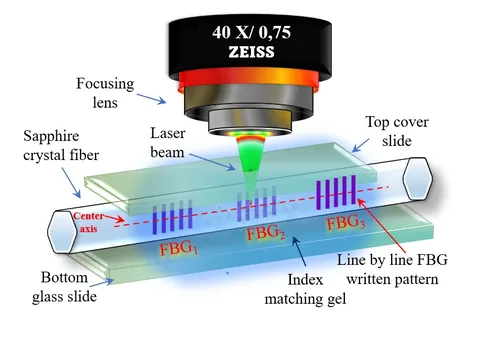
Unlocking Extreme-Temperature Sensing: The Breakthrough of Sapphire Fiber Bragg Gratings
How femtosecond-laser-written 1st-order sapphire Fiber Bragg Gratings avoid harmonic cross-talk, enabling 10-sensor cascaded arrays for thermal sensing to 1600°C.
An Introduction to Ultra-High-Temperature Ceramics for New Lab Members
A short primer on ultra-high-temperature ceramic (UHTC) systems, why they're studied, and where thermal measurement resolution becomes the limiting factor in understanding them.
Reading Recalescence: What the Crystallization Plateau Tells You
How a distributed thermal profile captures the recalescence event during solidification, and why its shape and position along a sample carry information a single point sensor cannot.
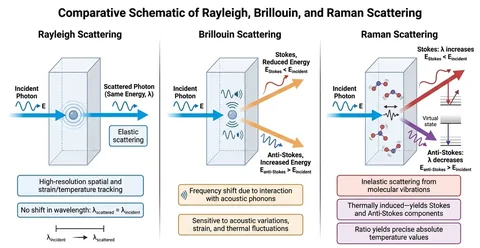
Distributed High-Temperature Optical Sensors: Advanced Thermal Profiling Architectures in Extreme Industrial Systems
A technical analysis of distributed high-temperature optical sensors, Raman/Brillouin scattering, and FO-DTS architectures for extreme environments.
What Distributed Temperature Sensing Shows That a Thermocouple Can’t
Why a single point measurement misses the phase-by-phase behavior that matters in high-temperature synthesis, and what a continuous fiber-optic thermal profile reveals instead.
The Case for In-Contact Thermal Data in Critical Mineral Processing
Surface pyrometry has blind spots in dusty, enclosed, or high-emissivity-uncertainty environments. In-contact distributed fiber sensing avoids them entirely.